
For those items that had been at first inventory, we have to determine how much work was DONE on them on this period to get them to the purpose of being transferred to the following process. For those objects within the ending inventory, it is the same as the weighted-average methodology, where we have to calculate how a lot work has been carried out to them already. At the tip of course of 1, our planners have their paper and ink able to be printed. Let’s assume we determine the ending WIP stock to be 35% complete as to the method. If we’ve one thousand models within the ending WIP inventory after process 1, this may equal 350, utilizing the formulation for equal items. We could then add these equal models to the ending WIP inventory for course of 1.

EUPs bring readability and precision to the messy world of multi-stage manufacturing, optimizing prices, inventory, and production. In a process costing system, the value of models transferred out of every department should be decided as well as the value of any partially completed items remaining within the division. Primarily Based on the earlier calculations, the following seven cost results can be determined.
- A complete production price report for the shaping division is illustrated in Determine 5.6 below.
- FIFO assumes that the oldest prices are assigned to the units accomplished first.
- In the current period, we transferred 500 units to course of 2, and have 350 equal models in our WIP stock.
- Equal models of manufacturing for materials equals the number of models in each group that had materials added in May.
For instance, if we bring 1,000 models to a 40 % state of completion, that is equivalent to 400 items (1,000 x 40%) which may be 100 percent complete. Accountants base this idea on the supposition that an organization should incur approximately the same quantity of prices to deliver 1,000 items to a 40% level of completion as it would to complete four hundred units. Calculating the started amount is a fundamental step in understanding the production course of and managing inventory successfully. The beginning work-in-process was valued at $66,000, consisting $20,000 of transferred-in costs, $30,000 of material costs, and $16,000 of conversion prices.
Monetary And Managerial Accounting
This represents the variety of items that had been already within the manufacturing course of firstly of the accounting period. These models are partially completed and will proceed to be labored on during the period. 4800 models × $2.09 plus the $658 of prices incurred for the start stock that was transferred out.
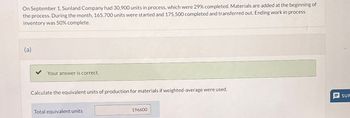
The equivalent units of manufacturing beneath the FIFO methodology include work done within the current interval only. So from our instance above, we now have 4925 equivalent units of manufacturing utilizing the weighted average technique. If our complete price of our beginning WIP inventory was $1,000 and we added $10,000 in the course of the period. Equal items of manufacturing is a crucial idea in price accounting, particularly for firms that manufacture products by way of a number of processes. It allows producers to precisely monitor production output and allocate costs even when some units usually are not but complete. In this comprehensive information I’ll clarify what equal items of manufacturing are why they matter, and stroll via the step-by-step process for calculating them.

This represents the variety of units that are nonetheless within the production process on the end of the accounting period. These units are partially completed and will require further processing earlier than they can be considered finished goods. Therefore, the began and completed unit of 75,000 units was computed by deducting the ending WIP (5,000 units) and starting WIP (10,000 units) from the whole models to account for of ninety,000 units. Targets of course of costing are to find out a manufacturing https://www.personal-accounting.org/ department’s price of finished goods during a month and the value of work in course of on the end of that month. Equal units beneath FIFO technique of course of costing are the number of completed items that could have been prepared in a process throughout a period had there been no unfinished items, either in opening WIP or closing WIP.
Understanding how to correctly calculate equal models is critical for process producers. By following the steps outlined, producers can reap the many advantages this metric supplies for optimizing operations and prices. So the entire equivalent items of manufacturing for Division A in January is 2,400 models. This supplies a exact measure of output incorporating each completed items and partial WIP. Our equivalent units of manufacturing for the interval is 1,200 models (700 + 500). Equivalent models of production discuss with the variety of absolutely accomplished items that would have been produced given the manufacturing work carried out throughout a period.
Understanding Work-in-process Stock
The equivalent items belonging to beginning stock represent the work carried out through the current interval to finish the units that weren’t accomplished within the earlier interval. The quantity transferred out will embody supplies prices incurred through the current period plus any quantity in starting stock. So the equal items provide a common measure of output that accounts for each finished goods and partial WIP. This permits manufacturers to accurately observe manufacturing volume and allocate prices. The shaping department accomplished 7,500 models and transferred them to the packaging department.
Step 3: Equivalent Units Of Ending Wip
Accountants name the combined labor and overhead prices conversion prices how to calculate the started and completed units. Conversion prices are these prices incurred to convert raw supplies into the ultimate product (meaning, direct labor and overhead). As Quickly As the equal models for supplies and conversion are identified, the fee per equal unit is computed in an identical method as the units accounted for. The prices for materials and conversion have to reconcile with the entire beginning stock and the costs incurred for the department during that month. As described beforehand, process costing can have a couple of work in process account.
Under the weighted average method, we use starting work in course of prices AND costs added this era. Beneath you’ll find an example of a mini-lesson that helped my pupil, Wanda, perceive how to calculate the started and completed models. The materials costs consisted of $30,000 in beginning inventory and $88,000 incurred during the month, for a total of $118,000. (3) Group three has 7,300 (given) models began this month to be accomplished subsequent month.